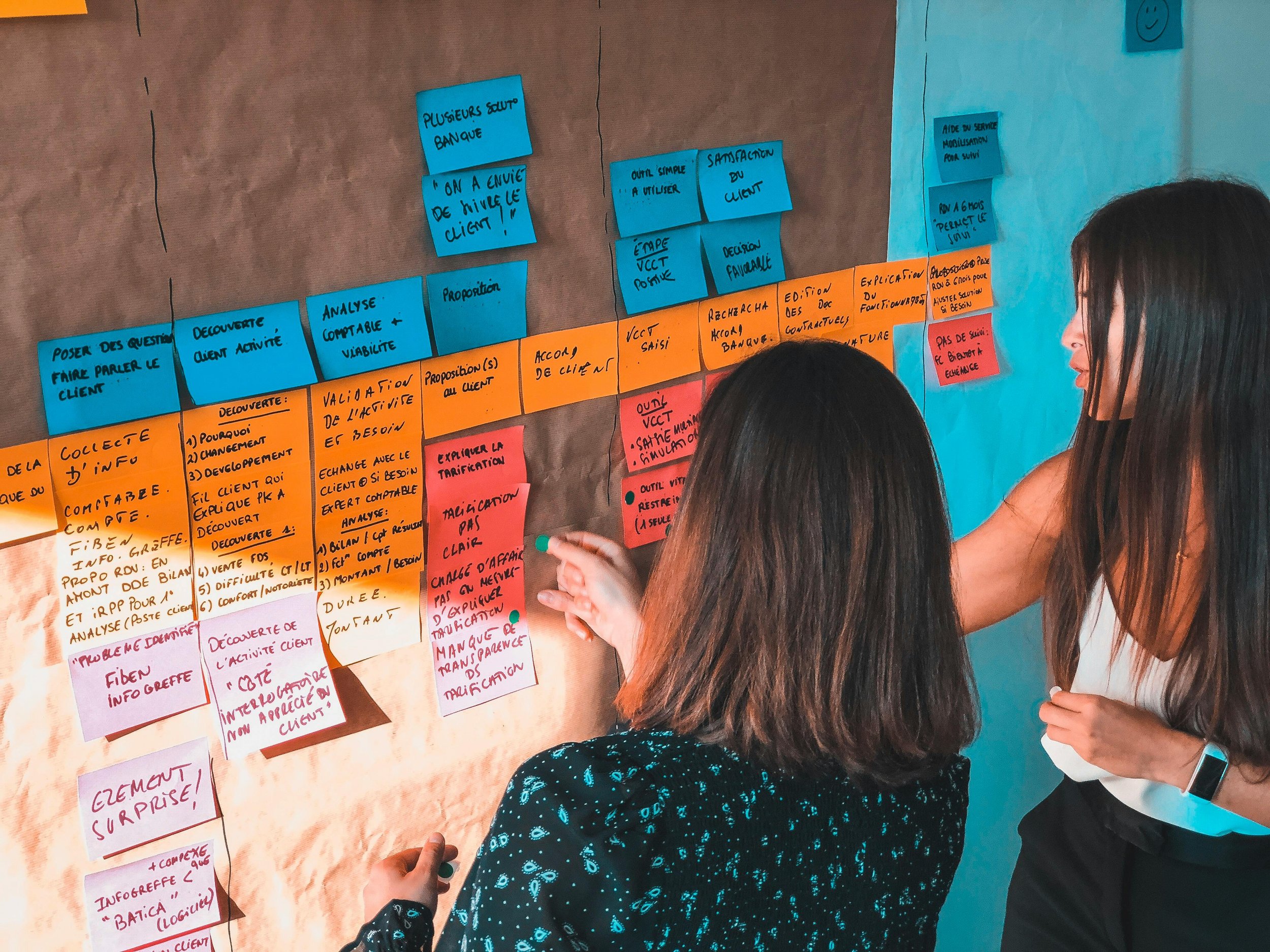
Design Spikes
How it works
A Design Spike is a 2-day rapid intervention that takes your team from uncertainty to a clear prototype plan — fast.
We build AI directly into the process to accelerate insight, ideation, and synthesis.
What it’s for
A Design Spike is shortened, intensive Design Sprint for teams who need to define and design a testable prototype in just two days. Typical uses include:
Shaping a brand-new product (digital or physical)
Designing or refining a new feature
Reworking a user flow or interaction pattern
Exploring alternative concepts before committing to build
Turning a vague idea into something concrete you can test
Ideal for product teams, founders, service designers, and anyone who needs to move from “idea” to “prototype-ready” fast.
What you’ll get
-
✺ Day 1
Frame and Explore
Define challenge & customer journey
AI-assisted ideation & persona role-play
Concept sketching + sharing -
✺ Day 2
Align and Plan
Prioritise and select best concepts
Define prototype blueprint (what to build, how to build it - with AI)
Draft test plan (who to test with, what to learn)
Create roadmap with owners -
✺ Day 3 (Optional)
Prototype and Test Prep
Create lightweight AI prototype assets
Write detailed test scripts
Hand over to team for execution & iteration
What we need from you
-
✺ People
About 6-8 willing participants.
This should be a mix of decision makers and SMEs.
Typically this includes whoever generally defines and designs the product direction, those who sell and promote it, those who understand the user or customer best, and whoever is responsible for signing off a new development.
-
✺ Time
A full two days of the group’s time and attention.
An in-person meeting works best for most cases, and is easier on the participants - but if that’s impossible for your organisation, we can work with you to organise a different structure remotely.
-
✺ Information
Part of the process is a deep-dive - so we’ll also ask for some background information and details- or experts who can pop in and provide this.
We can synthesise this ready for the session - but we’ll ask you to share what you can in advance for efficiency.
Why a Design Spike?

Built on a Tried-and-Tested Framework — Evolved for Today
Developed at Google Ventures, the traditional 5-day Design Sprint was created to fast-track critical product decisions. It guides teams through a full cycle — Understand, Sketch, Decide, Prototype, Test — in just one week.
But the classic format comes with trade-offs: a full design sprint demands 5+ days of focus from a 6–8 person team, often requires expensive external facilitation and prototyping support, and can weaken internal ownership of the outcomes. Modern AI tools help reduce these bottlenecks — shortening research, speeding up prototyping, and lowering the overall cost of running a sprint.


How Different Teams Use Design Spikes
A Design Spike helps teams move faster by enabling them to:
Product & UX: Validate features and flows quickly.
Marketing: Test messages and campaign ideas early.
Ops & Service: Improve processes and customer journeys.
Leadership & Strategy: Prototype future products, services, messages and branding.
Innovation & Commercial: Explore new opportunities with less risk.
Startups: Quickly iterate and explore scalable options.
AI Upskilling
A Design Spike helps teams build practical AI skills they can apply straight away. Teams learn how to use AI to accelerate research, enrich ideas, broaden perspectives, and challenge assumptions — supporting not just faster work, but deeper thinking.
Throughout the process, we work within your organisation’s AI policies, avoid sharing sensitive data, and use tools that fit the team’s comfort level. In this context, the team naturally builds confidence and capability with AI as part of the work.
The AI Difference
AI doesn’t just make a Design Spike faster — it makes it deeper. It broadens the team’s perspective by surfacing possibilities, patterns and insights that are hard to uncover in a typical workshop.
AI expands the range of ideas during ideation, sharpens definitions of users and opportunities, and helps teams explore multiple angles before converging.
It supports clearer prioritisation by combining human intuition with structured, data-driven reasoning.
It strengthens planning and communication, reduces cognitive bias during testing, and helps synthesise results with greater clarity. The outcome is not only increased speed, but more breadth, more depth, and better decisions.